
Moving a Sales & Marketing budget from a single line item to an objective-based structure with shared KPIs for sales and marketing
Purpose
Most SMB B2B companies carry one "Sales & Marketing" line on the P&L. Sales compensation dominates it, and marketing is a bullet point inside it. This document lays out the explicit steps to move from that structure to one organized by the job each dollar is meant to do: brand activation (building awareness and preference across the whole category) and sales activation (capturing and converting buyers who are in-market or already in the pipeline). It also makes the case for a section most budgets lack entirely: the assets and spend that sales and marketing must see and own together, including the shared KPIs both teams are held to.
The starting point
The legacy budget typically looks like this:
One combined Sales & Marketing number, set as last year's figure plus or minus a few percent
Sales compensation as the majority of the line (roughly 50-65%)
Sales expenses (travel, entertainment, events) in the sales column
"Marketing" as a handful of bullets: website, collateral, trade show booth, some ads, a freelancer
Digital ads as one number with no split between awareness and demand capture
Decisions made by the owner, CFO, or sales leader, with marketing rarely in the room
Success measured loosely: did the phone ring, did sales like the leads
The core problem is not that the numbers are wrong. It is that nobody can say what any dollar was supposed to accomplish, so nothing can be defended, measured, or improved, and marketing is the first line cut when revenue dips.
The Digital Success Framework
The target structure separates spend by objective, not by channel or department:
Foundation and infrastructure: CRM, automation, analytics, website platform, data
Brand activation: content and thought leadership, social, PR, sponsorships, brand creative
Sales activation: paid search and retargeting, lead gen, enablement, pipeline events, nurture
People and partners: agencies, freelancers, training
Measurement and optimization: reporting tools, research, win/loss interviews
Test and reserve: experiments and mid-year reallocation
Each bucket has an owner, a goal, and its own success metric. This is true even if the owner of all buckets is the same person.
The steps
Step 1: Pull marketing out of the sales line and see the real number
Before changing anything, find everything marketing-like hiding across the books: website costs, trade show fees booked as sales expenses, association dues, software subscriptions, freelancer invoices, sponsored events, and ad spend on company cards. Add it up. Most companies discover they spend more on marketing than anyone believed, and that no one has ever seen the total.
Output: a single list of every marketing-related dollar from the last 12 months, with its source.
Step 2: Tag every line by the job it does
Go line by line and tag each item as foundation, brand activation, sales activation, people and partners, measurement, or reserve. Some items serve two jobs. Tag them by primary purpose, and flag them for the shared-visibility list covered later in this document.
Output: the same list, now sorted into buckets, with a short list of items that straddle two.
Step 3: Agree on the definitions with sales, marketing, and finance together
The structure only works if everyone means the same thing by brand activation and sales activation. Hold one working session with the sales leader, whoever owns marketing, and finance. Agree on what each bucket is for, what belongs in it, and what it is not expected to deliver. Brand activation should not be judged on last-click leads. Sales activation should not be funded to build awareness.
Output: a one-page definitions sheet all three signed off on.
Step 4: Set one goal and one metric per bucket, plus shared KPIs
Give each bucket a goal that matches its job:
Foundation: uptime, data quality, tool adoption
Brand activation: share of search, direct and branded traffic, inbound mentions, unaided awareness where measurable
Sales activation: pipeline created, cost per opportunity, conversion rate by stage
Keep it to one or two metrics per bucket. A dashboard of twenty numbers is just a new way to ignore the data.
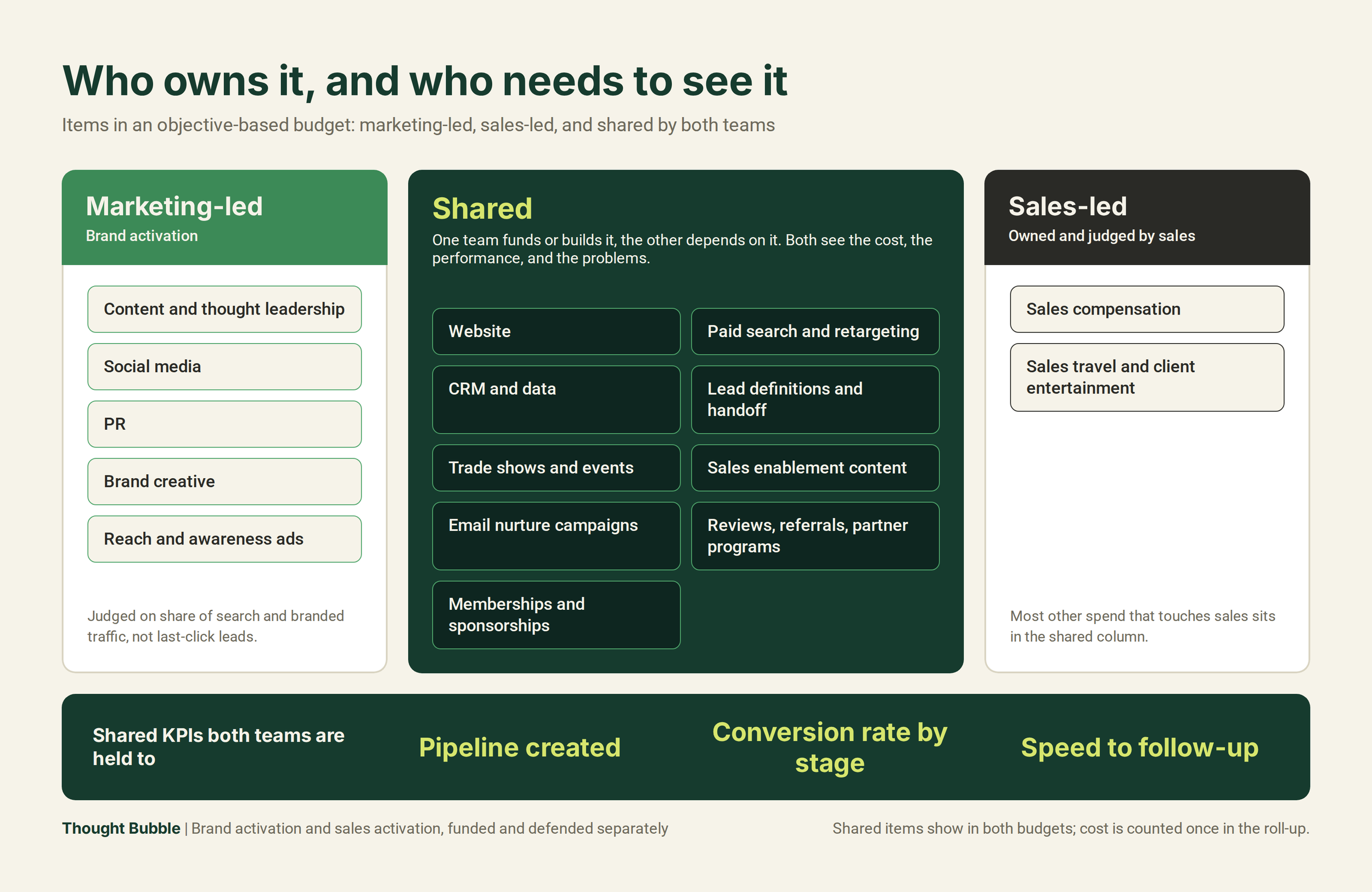
Then add a short list of shared KPIs for sales and marketing on top of the bucket metrics. Pipeline created, conversion rate by stage, and speed to follow-up work well because sales, marketing, and finance can all read them the same way, and neither team can hit them alone.
Output: a simple scorecard, one row per bucket.
Step 5: Rebuild the budget from goals, not from last year
Stop starting from last year's number. Start from the revenue target, work backward through win rate, opportunities needed, and pipeline needed, then decide how much of the gap comes from capturing existing demand versus building new demand. That split drives the allocation between sales activation and brand activation. A company with a strong pipeline gap leans toward sales activation. A company with low awareness in its market leans toward brand and foundation.
Output: a proposed allocation by bucket, with the reasoning behind it written down.
Step 6: Split the ad spend by objective
Digital ad spend should no longer be one number. Divide it into reach and awareness campaigns (brand activation) and search, retargeting, and lead gen (sales activation). This one change prevents the most common budget failure: judging awareness spend by sales metrics and then cutting it.
Output: two ad lines, each with its own metric.
Step 7: Assign owners and set the shared-visibility list
Every bucket gets one accountable owner. Every item on the shared-visibility list (next section) gets a primary owner and a named partner on the other side. Ownership should be visible in the budget document itself.
Output: an owner column on every line, and a shared-assets register.
Step 8: Set a review cadence
Quarterly is the minimum. Each review covers spend versus plan, metrics versus goal, and what moves from the reserve. Sales and marketing attend the same meeting. Finance joins at least twice a year.
Output: a recurring meeting with a standing agenda and the scorecard as its core document.
Step 9: Phase it in
Avoid a big-bang switch. A realistic path:
First 30 days: Steps 1-3. Visibility and definitions only. No budget changes.
Days 30-60: Steps 4-6. Draft the new structure alongside the old one.
Days 60-90: Steps 7-8. Assign owners, run the first shared review.
Next budget cycle: adopt the new structure as the official budget, with last year's legacy view kept for comparison.
Shared visibility: what sales and marketing must see together
In a legacy budget, some of the most important assets belong to marketing on paper but drive sales outcomes every day, and sales never looks at them. In an objective-based budget, these items need two sets of eyes: one team funds or builds them, the other depends on them. Both should see the cost, the performance, and the problems.
The website: your busiest and most vocal sales rep
The website works every hour of every day, talks to more prospects than any salesperson, and is often the first and last impression before a buyer ever speaks to anyone. Yet most sales teams rarely look at it, don't know what it says about pricing, positioning, or proof, and have never been asked what it should do better.
A website should be treated like a member of the sales team, with a budget, a quota, a manager, and a performance review.
Shared cost: the website's total cost, including hosting, maintenance, content, and redesign reserve, should be visible in both budgets. If it lives only in marketing, sales will treat it as someone else's problem.
Shared metrics: visits from key buyer segments, conversion rate to inquiry, demo or contact requests, and pipeline influenced.
Sales input required: the most common objections, the questions prospects ask first, the competitors they mention, and the proof points that close deals. Sales should review the key pages each quarter and flag anything outdated or wrong.
Once per quarter, consider a 30 minute '20 Most' meeting with sales and marketing together. Review one of the following each quarter.
20 most served web pages (from Search Console data)
20 most visited web pages (from Analytics)
20 most cited pages by AI (from a AI Visibility Tool like SEMRush)
20 most forgotten pages (from Analytics data and SEMRush rankings)
Don't revise or workshop the pages, just give them the sniff test to see if they need to be kept, killed, or combined.
Marketing duty: treat sales feedback as the brief for site changes, and report back on what changed.
Handoff check: someone should confirm that every form submission and contact request reaches a person, quickly, and that sales knows what the prospect looked at before reaching out.
Other items that need shared visibility
Paid search and retargeting. Marketing runs it, but sales feels the quality of the leads it delivers. Share cost per opportunity, not just cost per lead, and let sales weigh in on which keywords bring real buyers.
CRM and data. The most shared asset in the company, and usually the most neglected. Both sides should see adoption rates, data completeness, and duplicate or stale records. Poor CRM data quietly breaks every metric in the scorecard.
Lead definitions and handoff. The point at which a lead moves from marketing to sales is a shared responsibility, not a marketing deliverable. Define it jointly, track speed to follow-up, and review rejected leads together. This is where "the leads are bad" arguments get settled with facts.
Trade shows and events. Often booked in the sales expense column with the booth in marketing. Budget the whole event as one item: fees, travel, booth, collateral, and follow-up. Judge it by the category visibility it provided. Also judge it on pipeline created and the quality of conversations, not badge scans.
Sales enablement content. Decks, case studies, one-pagers, and battle cards are built by marketing and used by sales. Share the production cost and track usage: which assets sales actually uses, and which appear in closed-won deals.
Email nurture and lifecycle campaigns. These speak to prospects on behalf of sales. Sales should see the sequences, know who is receiving what, and be able to flag contacts who should be pulled out of a campaign.
Review sites, referrals, and partner programs. Customer proof is built across both teams. Sales knows who the happy customers are, and marketing knows how to turn them into reviews and case studies. Neither can do it alone.
Memberships and sponsorships. Association dues and sponsored events often sit in a corner of the budget with no owner. Bring them into the open and require a stated purpose, either brand activation or a defined sales opportunity, or let them lapse.
How to make shared visibility real
A shared-assets register. One page listing each shared item, its total cost, its primary owner, its partner on the other side, and the metric both teams will watch.
Dual line items. Show shared assets in both budgets with a note, so total cost is visible to everyone, with the cost counted once in the roll-up.
One scorecard, two audiences. Sales and marketing look at the same shared KPIs in the same meeting. No separate versions.
A standing sales review of customer-facing assets. Quarterly, sales reviews the website, key decks, and nurture emails, and logs what is wrong or missing.
A feedback loop with a deadline. Every sales comment gets a response and a decision within a set time, even if the answer is no.
Common pitfalls
Changing the structure without changing the conversation. If sales and finance still judge everything by last-click leads, the new buckets are just new labels.
Too many metrics. One or two per bucket. More than that means no one is accountable for any of them.
Treating the website as a project instead of a team member. A rebuild every four years is not a strategy. Ongoing ownership and a quarterly review are.
Skipping finance. The CFO is often the person who cuts marketing first. Bring them into the definitions session so the logic is theirs too.
Over-allocating to brand or sales activation too fast. Shift in steps, and use the reserve to test before committing a larger share.
Leaving shared items without a named owner. If everyone is responsible, no one is.
What good looks like after one year
Finance, sales, and marketing can all state what each dollar was meant to do
Brand activation and sales activation are funded and judged separately
The website has an owner, a scorecard, and a quarterly sales review
Lead handoff is defined, measured, and no longer argued about
Marketing is a defended investment, not the first thing cut
The budget is built from revenue goals, not from last year's number