The question assumes the two do the same job at different prices. They don’t. Most agencies are built to carry out work with strategy at the front end to pull the work through. A consultant is built to decide what work is worth doing, and how much of the budget it deserves. The more useful question is which one you need first.
What each one is built to do
An agency sells execution: advertising, content, SEO, creative, web work. Its team, tools and pricing are organized around producing that work month after month. That’s a real strength when you know what you need produced.
A consultant sells judgment. The deliverable is a strategy and a budget: what marketing is for, how much to spend, where, and how you will know it worked. A strategy engagement is usually a defined project with a start and an end. An agency relationship is usually an ongoing retainer.
The built-in pull of agency strategy
Many agencies offer strategy, and much of it is good. But strategy that comes from a company selling execution has a natural gravity. A paid media agency tends to find that paid media is the answer. A content agency tends to find that content is. Nobody has to act in bad faith for this to happen. People recommend what they know how to deliver.
For leaders, the result can be a plan that fits the vendor’s service list better than it fits the business. Marketing spend grows as one line. Sales sees leads arrive. Finance asks what the money bought. Nobody can say which dollars were meant to build awareness and preference, and which were meant to create pipeline now.
I should be upfront: Thought Bubble also manages paid advertising, writes content and does SEO for clients. I have a stake in this question too. That’s why I sell strategy as its own engagement, with no obligation to buy anything else from me.
What a standalone strategy engagement gives you
A plan that can say “no” or “not yet.” When the advisor has nothing to sell you afterward, the recommendations can include spending less on a channel, doing a task in-house, or waiting.
Two jobs, funded separately. Brand activation and sales activation do different work, on different timelines, with different measures. A standalone strategy sets an objective, a budget and a measure for each. Leaders can then see each one, fund it and defend it on its own terms, instead of defending one big line.
A brief you own. The strategy belongs to you. You can hand it to any agency, compare their proposals on equal footing, or run parts of it yourself.
One language for three departments. Sales, marketing and finance each get a version of the plan they can use. The CFO sees what each budget line is meant to do. The sales leader sees which spend supports pipeline. The marketing leader gets a defensible basis for the work.
When an agency is the right call
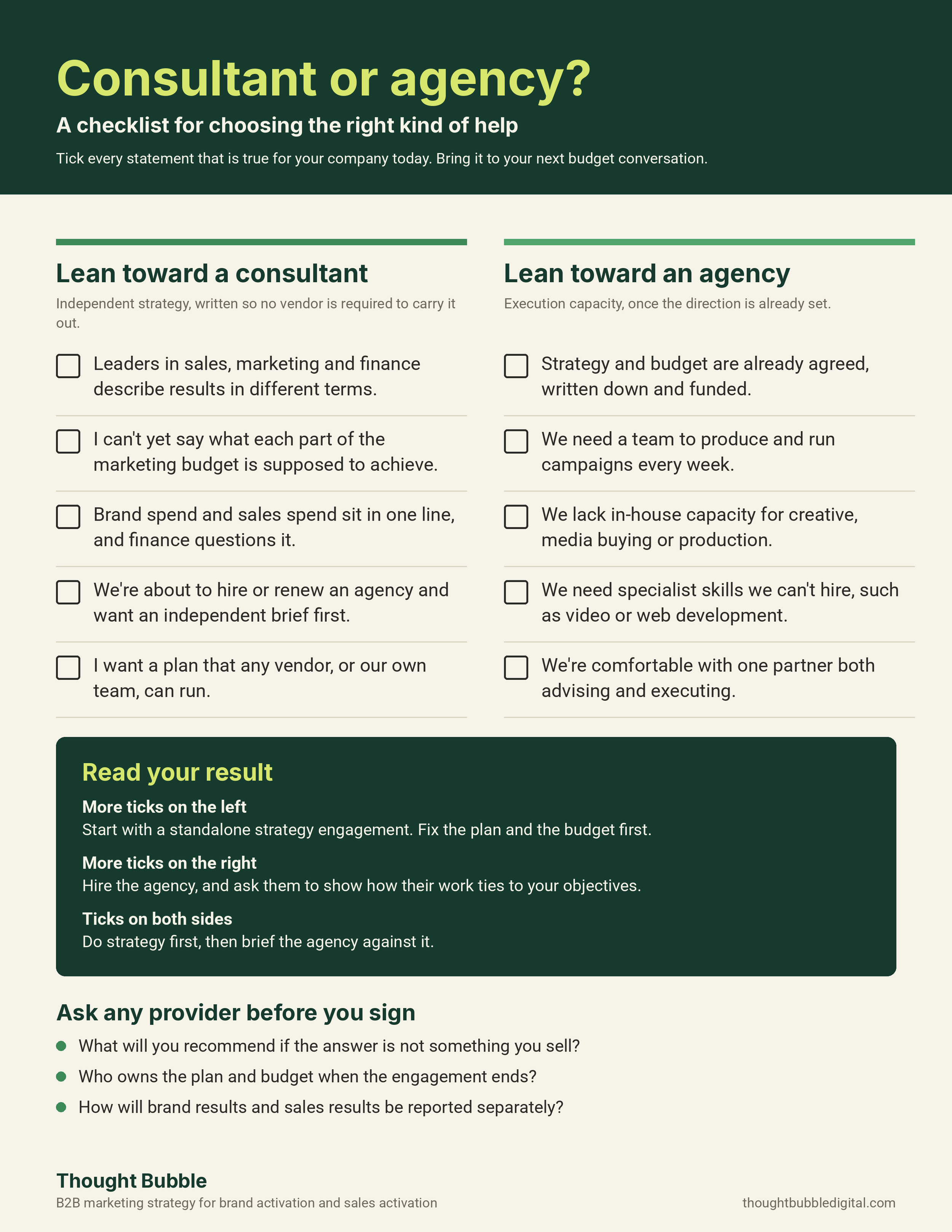
Sometimes you don’t need strategy first. An agency is likely the better fit when:
Your strategy and budget are already agreed, written down and funded
You need a team to produce and run campaigns every week
You need specialist skills you can’t hire, such as video or web development
Many companies need both, in order. Strategy comes first. Then you hire the agency against a brief that sets out what the work must accomplish. That order gives you leverage. Proposals become easy to compare, and the agency’s results can be judged against objectives you set, not ones it chose.
Questions to bring into the room
Whichever route you take, these questions work in a meeting with sales, marketing and finance:
What will you recommend if the answer isn’t something you sell? A consultant with nothing to pull through can answer this easily. An agency should be able to answer it honestly.
Who owns the plan and the budget when the engagement ends? You should be able to take both with you.
How will brand results and sales results be reported separately? If the answer is one blended number, the budget will be hard to defend later.
What would have to be true for us to spend less? A good advisor can name the conditions.
Use the checklist
I’ve put these questions and the decision points into a one-page checklist. Print it, tick the statements that are true for your company today, and bring it to your next budget conversation. The ticks show whether you need a standalone strategy first, an agency now, or both in sequence.
If most of your ticks land on the consultant side, a strategy engagement is the right first step, and I’d be glad to talk it through.